

CIVIC Youth Brazil Engagement Program Pillars
The Brazil Engagement Program hosted under the CIVIC Youth Platform is built on three interconnected pillars designed to move from knowledge to action, equipping youth with the tools, platforms, and resources to engage meaningfully in public policy, development processes, and job creation pathways.

Together, these pillars bridge the gap between youth participation and development outcomes, particularly in Brazil’s Northeast, where structural barriers to opportunity remain highest.


Pillar 1
Capacity Building
Capacity Learning Through E-learning Courses
Youth-designed training for youth with World Bank team and partners

Pillar 2
Building a Community of Practice
From Learning to Application

Youth engagement often ends at consultation, with limited influence on decision-making.

Pillar 3
Innovation Funds
From Ideas to Implementation
Youth-led groups often struggle to access formal financing and economic opportunities.
Pillar 1
Capacity Building
While youth organizations bring deep community knowledge, they often lack access to technical policy processes.
The Brazil Engagement Program strengthens both youth capacity and institutional readiness, ensuring that participation is informed, credible, and actionable. In doing so, the first pillar targets both CSOs and WBG staff - sensitizing both on existing participatory mechanisms for youth on a national and institutional level.
Jovens em Ação
The course demystifies entry points for youth participation in Brazil from national planning instruments like the Plano Plurianual (PPA) to international development financing.
An online national training course designed to equip young people with:
- Understanding of Brazil’s public policy and budget systems
- Insight into how development financing works
- Tools to engage in consultation, monitoring, and accountability processes
Open Learning Campus (OLC) Course for World Bank Teams
This course equips WBG staff with the knowhow around feasible participatory mechanisms within the WBG, and explores important safeguards that can inform engagement with young people through working more systematically with youth-led and youth-serving CSOs.
A complementary course designed for World Bank operational teams, providing:
- Practical tools to integrate youth engagement into projects
- Guidance on partnering with youth-led and youth-serving organizations
- Real-world examples linking youth engagement to jobs, climate, and social inclusion
Pillar 2
Community of Practice: From Learning to Application
Youth engagement often ends at consultation, with limited influence on decision-making.
The CoP creates a continuous engagement mechanism, ensuring youth perspectives inform planning, financing, and implementation, not just dialogue.
The Community of Practice (CoP), developed in partnership with the International Youth Foundation (IYF), provides a structured platform for sustained engagement, enabling youth to apply their knowledge in real policy and development processes.
Following the Jovens em Ação training, youth participants join a facilitated platform that supports:
- Engagement with national participation mechanisms such as Participativo Brasil
- Peer-to-peer exchange across youth-led and youth-serving organizations
- Development of policy-relevant inputs aligned with national priorities
Core functions:
- Translating youth ideas into actionable policy contributions
- Connecting grassroots innovation with institutional processes
- Strengthening collaboration between youth, government, and development actors
Pillar 3
Innovation Funds: From Ideas to Implementation
Youth-led groups often struggle to access formal financing and economic opportunities.
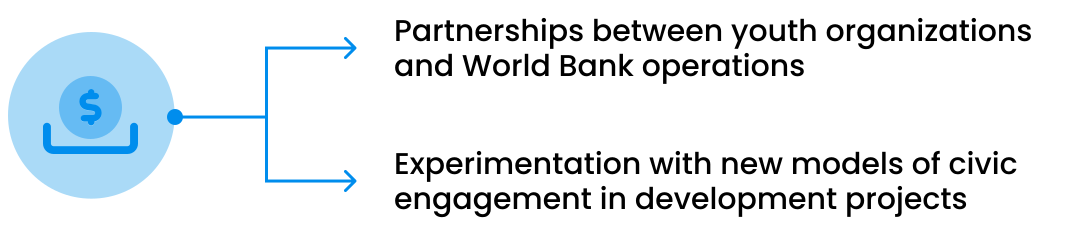
This pillar creates a bridge between grassroots' innovation and development systems, enabling ideas to be tested, refined, and scaled within real World Bank operations.
To support this pillar, CIVIC is working in collaboration with IFC Brazil and Itaú Unibanco to deliver flexible financial literacy initiatives targeting marginalized young women, combining private sector reach with civil society trust networks.
What this supports: